Quick Answer:
-
Indian investors can sell Dubai property remotely using a notarized Power of Attorney without visiting the UAE
-
Dubai imposes zero capital gains tax on property sales, so every dirham of profit stays with the seller
-
The total seller cost to sell Dubai property is approximately 2 to 4% of the sale price, covering NOC and agent fees
-
The full process from listing to funds received takes 4 to 8 weeks in normal market conditions
-
Sale proceeds can be repatriated to India freely, though Indian capital gains tax may apply under DTAA rules
Every Dubai property sale is a tax-free event on the UAE side, but most Indian investors who bought between 2020 and 2024 are now sitting on significant unrealised gains and have no clear plan for how to exit. Dubai's real estate market recorded AED 917 billion in transactions in 2025, the strongest year in the emirate's history, and a significant portion of that inventory was bought by overseas investors between 2020 and 2023 who are now asking: how do I sell and get my money out?
The answer is clear: you can sell Dubai property entirely from India, collect a tax-free gain in the UAE, and repatriate proceeds through compliant channels. Mid-range apartments in Dubai Marina and Business Bay are yielding 6 to 7% annually, and investors holding rental-ready properties are well-positioned to sell at a solid premium in 2026.
This guide covers every step Indian investors need to sell Dubai property in 2026 the correct selling sequence, seller costs, the zero capital gains advantage, India-side tax obligations, how to close remotely through a Power of Attorney, and exactly how to repatriate your proceeds back to India.
Is Now Right to Sell?
Before deciding to sell Dubai property, Indian investors need to understand where the 2026 market stands, what returns sellers are realistically capturing, and which asset types are moving fastest. Getting this context right prevents premature exits that leave value on the table.
Market Conditions 2026
Dubai's property market in 2025 to 2026 is entering a late-expansion and stabilisation phase. After years of sharp price growth, the market is maturing, which means strategy matters more than it did during the 2022 to 2024 boom. Supply is increasing in many mid-market segments, and buyer competition is lower than at the peak.
Current market signals for sellers:
-
Apartments account for 50,343 of the 61,437 total transactions registered in 2026 year to date, according to Property Monitor
-
One-bedroom apartments represent 35.4% of all transactions in the market
-
Well-priced studio and one-bedroom units in high-demand zones attract offers within weeks
-
Sellers of villa units should budget for a 60 to 120 day sales cycle as a realistic expectation rather than an exception
-
Tenanted properties with strong yield histories command a premium from investor buyers
The 2026 market rewards sellers who price correctly from day one. Overpricing is the single biggest reason properties sit unsold in Dubai, and the DLD's valuation tool provides live registered transaction data to set a defensible asking price. Understanding market conditions before engaging an agent ensures your pricing strategy is data-led rather than aspirational.
Returns Indian Sellers Made
Indian investors who purchased freehold property in Dubai during the 2020 to 2023 cycle have seen strong capital appreciation across most zones, driven by population growth, Golden Visa reform, and sustained international demand.
|
Zone |
Avg Purchase Price 2021 (AED) |
Avg Price 2026 (AED) |
Estimated Gain % |
|
Dubai Marina (1-bed) |
900,000 |
1,400,000 |
55% |
|
Business Bay (1-bed) |
700,000 |
1,050,000 |
50% |
|
JVC (studio) |
280,000 |
420,000 |
50% |
|
Downtown Dubai (1-bed) |
1,400,000 |
2,100,000 |
50% |
|
Dubai Hills Estate (2-bed) |
1,100,000 |
1,600,000 |
45% |
One major advantage of choosing to sell Dubai property: there is zero capital gains tax. Every dirham of profit is yours. For an Indian investor who bought a JVC studio for AED 280,000 in 2021 and sells for AED 420,000 in 2026, the AED 140,000 gain, approximately INR 32.9 lakh, leaves the UAE entirely untaxed. Capturing these gains while the appreciation cycle is still strong is the most common reason experienced Indian investors choose this moment to sell Dubai property.
Best Asset Types
Not all Dubai assets sell equally in 2026. Understanding which property types generate the fastest, highest-value exits helps Indian investors decide whether to sell now or hold for another cycle.
Fastest-selling asset profiles for Indian sellers:
-
Studio and 1-bed apartments in Business Bay, JVC, and JLT: largest buyer pool, fastest offer timelines
-
Tenanted apartments with Ejari-registered leases: strong appeal to yield-seeking investors who want immediate income
-
Emaar-branded properties at any price tier: brand premium drives faster DLD transfer and stronger resale pricing
-
Properties near metro stations: consistently command 10 to 15% price premium over car-dependent equivalents
Villas and larger units take longer to move but typically command stronger per-square-foot gains. Matching your asset type to the current buyer appetite before listing sets realistic timeline expectations and helps your agent price and position the property correctly from the first day on the market.
The decision to sell Dubai property is not just a financial one — it is also strategic, and timing matters significantly when the market is in a late-expansion phase with supply increasing across several mid-market segments.
Step-by-Step Selling Process
Selling property in Dubai is more straightforward than most people expect, but only if you understand the process before starting. Get the sequence wrong, miss a document, or underestimate the fees, and a smooth transaction can stall for weeks.
Price and List
The first step when you decide to sell Dubai property is setting a realistic, data-backed asking price. The DLD's Valuation Tool at dubailand.gov.ae shows recent registered transaction prices for your specific community, building, and unit type, giving you a defensible baseline before engaging any agent.
Once you set the price:
-
List exclusively with one RERA-certified agent or list with multiple for maximum exposure
-
Verify any agent via the Dubai REST App or the DLD licensed brokers directory before signing anything
-
Agree the listing agreement in writing, specifying the agent's commission rate and exclusivity terms
-
Authorise professional photography and portal listings on Property Finder and Bayut
-
Review all offers through your agent, who presents them in writing with proof of buyer funds
Setting the correct price from day one is the single most important decision in the listing process. An overpriced listing alienates serious buyers in the first two weeks, and reducing price later signals desperation that drives offers lower.
MOU and NOC
Once a buyer is found and a price agreed, both parties sign a Memorandum of Understanding (MOU, also called Form F). The buyer pays a 10% deposit to the seller's agent, held in escrow. You then apply for a No Objection Certificate from the original developer.
The NOC is a mandatory clearance letter from the original developer confirming that all service charges are paid and the property can be transferred.
|
Developer |
NOC Fee (AED) |
Processing Time |
|
Emaar |
500–1,000 |
3–5 business days |
|
DAMAC |
1,000–2,500 |
5–7 business days |
|
Binghatti |
500–1,500 |
3–5 business days |
|
Smaller developers |
2,500–5,000 |
Up to 14 business days |
|
Standard range |
500–5,000 |
3–10 business days |
You cannot complete the transfer at the DLD without this document, so apply for it early in the sales process. Applying for the NOC on the same day as MOU signing prevents the most common source of delay in Dubai property transactions. Once the NOC is issued, the transaction moves immediately to DLD transfer day.
DLD Transfer Day
Transfer day at the DLD Trustee Office is the final legal step to sell Dubai property. Both buyer and seller must be present, either in person or through a valid Power of Attorney. The buyer's funds are verified, all fees are paid, and the DLD issues the new Title Deed in the buyer's name on the same day.
|
Step |
Party Responsible |
Timing |
|
Liability letter from bank |
Seller (if mortgaged) |
Before transfer day |
|
NOC from developer |
Seller |
Before transfer day |
|
Buyer funds confirmation |
Buyer's agent |
Morning of transfer |
|
4% DLD transfer fee payment |
Buyer (or split 2%/2%) |
At Trustee Office |
|
Seller receives net proceeds |
Seller's agent |
Same day as transfer |
|
New Title Deed issued |
DLD |
Same day |
Total realistic timeline from listing to funds received is 4 to 8 weeks in a normal market. For Indian sellers managing this remotely from India, a Power of Attorney allows a representative to attend transfer day on your behalf, removing the need to travel. Once transfer is confirmed and all parties paid, your sale proceeds are released the same day.
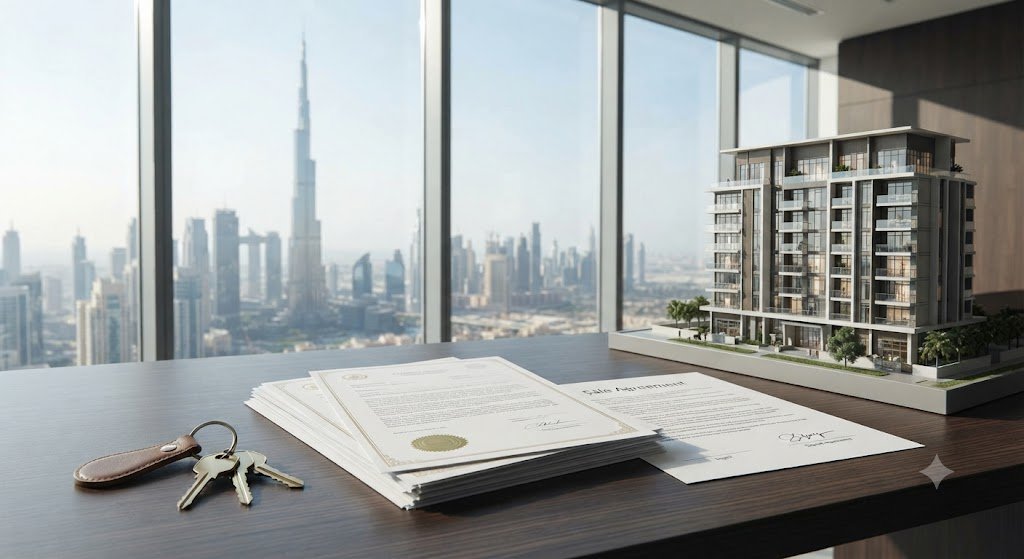
The process to sell Dubai property follows a defined sequence regulated by the DLD. Each step triggers the next, and no step can be skipped or reordered without causing delays.
Selling Costs for Indians
Understanding every cost before you sell Dubai property prevents unwelcome surprises that reduce your net proceeds. The seller's cost structure in Dubai is significantly lighter than the buyer's, but it still requires proper budgeting before you accept any offer.
Dubai-Side Fees
The seller's primary financial obligations in Dubai when you sell Dubai property are three: the NOC fee, the agent commission if applicable, and the mortgage discharge fee if the property carries an outstanding loan.
Seller cost summary:
|
Cost Item |
Amount |
Notes |
|
NOC fee |
AED 500–5,000 |
Paid to developer, mandatory |
|
Agent commission |
2% + 5% VAT |
Only if using an agent |
|
Mortgage discharge fee |
AED 1,000 |
Only if property is mortgaged |
|
DLD transfer fee (seller share) |
0–2% of sale price |
Often paid by buyer in full |
|
Total seller cost |
2–4% of sale price |
Depends on mortgage status |
Dubai has no annual property tax, no capital gains tax, and no tax on rental income, making it one of the most tax-efficient real estate markets globally. The seller's cost structure to sell Dubai property is dramatically lower than most markets — no conveyancing solicitor fees, no land transfer tax on the seller, and no inheritance or estate levy on the proceeds.
Zero Capital Gains
Dubai does not impose capital gains tax on property resale. If you purchase a property for AED 1,500,000 and sell it later for AED 1,900,000, the profit is not taxed at the federal or emirate level. This is one of the structural advantages that makes Dubai among the most attractive exit markets for Indian investors globally.
Comparing capital gains tax when you sell property in Dubai versus other markets Indian investors use:
|
Market |
Capital Gains Tax on Property |
Annual Property Tax |
|
Dubai |
0% |
0% |
|
India (long-term) |
20% with indexation |
Applicable |
|
UK |
Up to 24% |
Council tax annually |
|
Australia |
Up to 45% marginal rate |
Land tax varies by state |
|
Canada |
50% of gain included in income |
Property tax annually |
Unlike India, where long-term capital gains on property are taxed at 20% with indexation, Dubai imposes no tax on property sale profits or rental income at the emirate level. For an Indian investor capturing a AED 400,000 gain when they sell Dubai property, this zero-tax exit preserves the full INR 94 lakh gain that an Indian domestic property exit would reduce by 20% or more.
India-Side Tax Rules
While Dubai imposes zero tax when you sell Dubai property, Indian investors have India-side obligations that must be handled correctly in the year of sale.
India-side tax obligations when you sell Dubai property:
-
Long-term capital gains: 20% with indexation if the asset is held more than 24 months, under Indian tax law
-
Short-term capital gains: taxed at your applicable income slab rate if held under 24 months
-
Schedule FA disclosure: mandatory foreign asset declaration in your Indian ITR every year
-
DTAA relief: NRIs may qualify for exemption via UAE tax residency under the India-UAE DTAA if they can establish tax residency in the UAE
-
Sale proceeds declaration: the full sale amount must be reported under Schedule FSI in your Indian ITR for the relevant financial year
Engage a FEMA-qualified CA before the sale completes to structure the India-side reporting correctly. The DTAA between India and the UAE can reduce or eliminate Indian capital gains liability for investors with established UAE tax residency, but this requires professional advice specific to your residency status and holding period.
The zero-tax advantage is the most important financial fact for Indian investors deciding whether to sell Dubai property now or hold further. No other major market accessible to Indian investors under LRS offers a comparable after-tax exit structure.
Selling Remotely from India
One of the most important practical questions for Indian investors is whether they need to travel to Dubai to sell Dubai property. The short answer is no. The full transaction can be completed remotely through a notarized Power of Attorney, with the right sequence of steps followed from India.
Power of Attorney
A notarized Power of Attorney (POA) allows a trusted representative in Dubai to attend the DLD Trustee Office on your behalf, sign the transfer documents, and collect the sale proceeds on the day of transfer. Without a POA, you must be physically present at the DLD Trustee Office for the final transfer.
Steps to set up a POA from India to sell Dubai property remotely:
-
Draft the POA document specifying the representative's authority over the sale transaction
-
Get the POA notarized in India by a registered notary
-
Attest the notarized POA at the UAE Consulate in India (Mumbai, Delhi, or Chennai)
-
Send the attested POA to your representative in Dubai for use at the DLD Trustee Office
The POA process typically takes 5 to 10 business days from drafting to delivery in Dubai. Starting the POA process simultaneously with the NOC application prevents any delay between NOC issuance and DLD transfer day. Your RERA-registered agent can recommend trusted POA representatives or law firms who regularly handle overseas seller transactions.
Agent Selection Tips
Selecting the right RERA-registered agent is the most important decision in the remote selling process. A strong agent handles pricing, listing, buyer qualification, MOU drafting, NOC coordination, and DLD transfer coordination on your behalf while you remain in India.
Key criteria for selecting your selling agent:
-
Confirmed RERA registration verifiable at dubailand.gov.ae
-
Proven track record of selling in your specific building or community
-
Experience managing overseas seller transactions via POA
-
Clear written agreement on commission rate, exclusivity period, and minimum listing price
-
Digital reporting capability so you can track offers and buyer activity remotely
The standard commission is 2% of the final sale price plus 5% VAT, typically paid by the buyer in secondary market transactions. In some negotiations, the commission is shared between buyer's and seller's agents. Confirm the commission structure in writing before signing any listing agreement to avoid disputes at the close of sale.
Repatriating Sale Proceeds
Dubai imposes no capital gains tax, no withholding tax on property sales, and no restrictions on repatriating sale proceeds overseas. Once the DLD transfer completes, your net sale proceeds can be wired directly to your Indian bank account the same day, with no UAE government restriction on the transfer.
Repatriation process for Indian sellers:
|
Step |
Action |
Who Does It |
|
1 |
Receive net proceeds from DLD transfer |
Seller's agent or POA holder |
|
2 |
Wire proceeds from UAE to Indian bank account |
UAE bank or exchange house |
|
3 |
Declare inbound foreign remittance |
Your Indian bank (Form A2 equivalent) |
|
4 |
Report capital gain under Schedule FSI |
Your FEMA-qualified CA |
|
5 |
Apply DTAA relief if eligible |
CA on your behalf |
|
6 |
Pay Indian capital gains tax if applicable |
Filed with annual ITR |
Using a bank wire for large amounts rather than a currency exchange service protects the full transfer amount from intermediary margins. Currency exchange rates between AED and INR move with the USD-INR relationship, so timing large transfers can make a meaningful difference on remittances above INR 1 crore.
Most overseas sellers lose time and money by starting in the wrong order. Here is the right order. The remote selling process is entirely achievable, but requires specific documentation that must be prepared and notarized before the transaction moves to DLD transfer day.
Special Cases for Sellers
Beyond the standard resale process, three specific seller scenarios require additional steps that catch Indian investors off guard if they are not anticipated in advance. Knowing which scenario applies to your asset prevents delays and additional costs during the sale.
Tenanted Property Rules
Selling a tenanted Dubai property is legally permitted at any time, but the tenant's rights create obligations for both the seller and the new buyer. A tenant with an active Ejari-registered tenancy has the right to remain in the property until the lease expires, even after ownership transfers.
Key tenanted property seller obligations:
-
You must give the tenant 12 months' written notice if the new owner intends to use the property personally, and this notice must be served via notary
-
The buyer takes over as landlord and inherits all existing tenancy obligations
-
Make sure the tenancy terms are fully disclosed in the MOU so the buyer has no grounds to dispute them later
-
Tenanted properties in desirable rental zones often sell at a premium to investor buyers who value the immediate yield
Tenanted properties targeting yield-focused buyers are actually easier to sell than vacant units in most zones because the buyer receives immediate income. Disclosing all tenancy details upfront in the MOU protects the seller from post-transfer disputes.
Off-Plan Resale Rules
If you purchased off-plan and want to sell before handover, the process is different from a ready property sale. You are selling your right to the unit rather than the unit itself, and the developer's consent and a sub-sale agreement are required.
Key off-plan resale requirements:
-
Developer must approve the sub-sale — not all developers permit it before a minimum payment percentage
-
Most developers require 30 to 40% of the total purchase price to be paid before permitting a sub-sale
-
The new buyer takes over your original payment plan for the remaining balance
-
A DLD Oqood transfer fee applies instead of the standard DLD transfer fee
-
Profit on the sub-sale is still zero-taxed in Dubai
Check your original SPA for sub-sale clauses before listing. Some developers impose a sub-sale fee of 1 to 2% of the sale price in addition to the standard NOC fee.
Mortgaged Property Sale
Selling a mortgaged property adds your bank as a third party to the transaction. Your bank becomes a party to the transaction and must issue a liability letter confirming the outstanding balance. The buyer's funds are used to settle your outstanding loan first. Once the mortgage is discharged, the bank issues a clearance letter and releases the original title deed, enabling the DLD transfer to proceed.
Steps specific to mortgaged property sales:
-
Request a liability letter from your UAE bank (typically valid for 15 days)
-
Share the liability letter with the buyer's agent to confirm the net proceeds you will receive
-
Budget AED 1,000 for the mortgage discharge fee at the DLD
-
If both buyer and seller have mortgages, two banks are coordinating — allow an extended timeline of 6 to 10 weeks
-
Confirm that the sale price covers the outstanding mortgage balance before accepting any offer
Sellers with mortgaged assets should instruct their agent to only accept offers where the buyer's funds clearly cover the outstanding loan balance plus all seller costs. Short-sale situations where the sale price does not cover the mortgage balance require bank negotiation before the transaction can proceed.
Ready to Sell Today?
The decision to sell Dubai property in 2026 puts Indian investors in one of the world's most seller-friendly tax environments zero capital gains, zero withholding tax, and full freedom to repatriate every dirham of profit back to India.
Register at dubaipropertiesexpo.co.in to connect with DLD-verified developers and advisors who can guide your exit strategy and help you reinvest proceeds into the next high-yield Dubai asset.
Frequently Asked Questions
Is there capital gains tax when I sell Dubai property?
No. Dubai imposes zero capital gains tax when you sell Dubai property, meaning every dirham of profit belongs entirely to the seller. This applies equally to UAE nationals and foreign investors including Indian buyers. However, Indian residents must still declare the capital gain in their Indian income tax return under Schedule FSI and may be liable for long-term capital gains tax in India at 20% with indexation if the asset was held for more than 24 months. NRIs with established UAE tax residency may qualify for exemption under the India-UAE DTAA.
How long does it take to sell Dubai property?
The realistic total timeline from listing to funds received is 4 to 8 weeks in a normal market. For studio and one-bedroom apartments in high-demand zones like JVC and Business Bay, well-priced units typically receive offers within two to three weeks of listing. Villa and larger unit sales take 60 to 120 days from listing to DLD transfer. The NOC from the developer adds 3 to 14 business days depending on the developer, and the DLD transfer itself completes on the day of the Trustee Office appointment.
Can I sell Dubai property without visiting Dubai?
Yes. Indian investors can sell Dubai property entirely remotely using a notarized Power of Attorney. The POA must be drafted in India, notarized by a registered notary, attested at the UAE Consulate in India, and delivered to a trusted representative in Dubai who attends the DLD Trustee Office on your behalf. Your RERA-registered agent coordinates the entire process remotely, including MOU signing, NOC application, and DLD transfer scheduling, while you manage everything from India.
What fees do I pay when I sell Dubai property?
Seller costs to sell Dubai property are significantly lighter than buyer costs. The primary seller obligations are the NOC fee from the developer, ranging from AED 500 to AED 5,000 depending on the developer, and the agent commission of 2% plus 5% VAT if you use an agent. If the property has an outstanding mortgage, an AED 1,000 mortgage discharge fee applies. The 4% DLD transfer fee is typically paid by the buyer, though it is sometimes split 2% each by prior agreement in the MOU.
How do I repatriate sale proceeds from Dubai to India?
Dubai imposes no capital gains tax, no withholding tax on property sales, and no restrictions on repatriating sale proceeds overseas. Once the DLD transfer completes, your net proceeds can be wired directly to your Indian bank account the same day through a UAE bank international transfer. Your Indian bank records the inbound remittance, and your FEMA-qualified CA files the capital gain under Schedule FSI in your Indian ITR for the relevant financial year. Apply India-UAE DTAA provisions to reduce or eliminate Indian capital gains liability where eligible.