




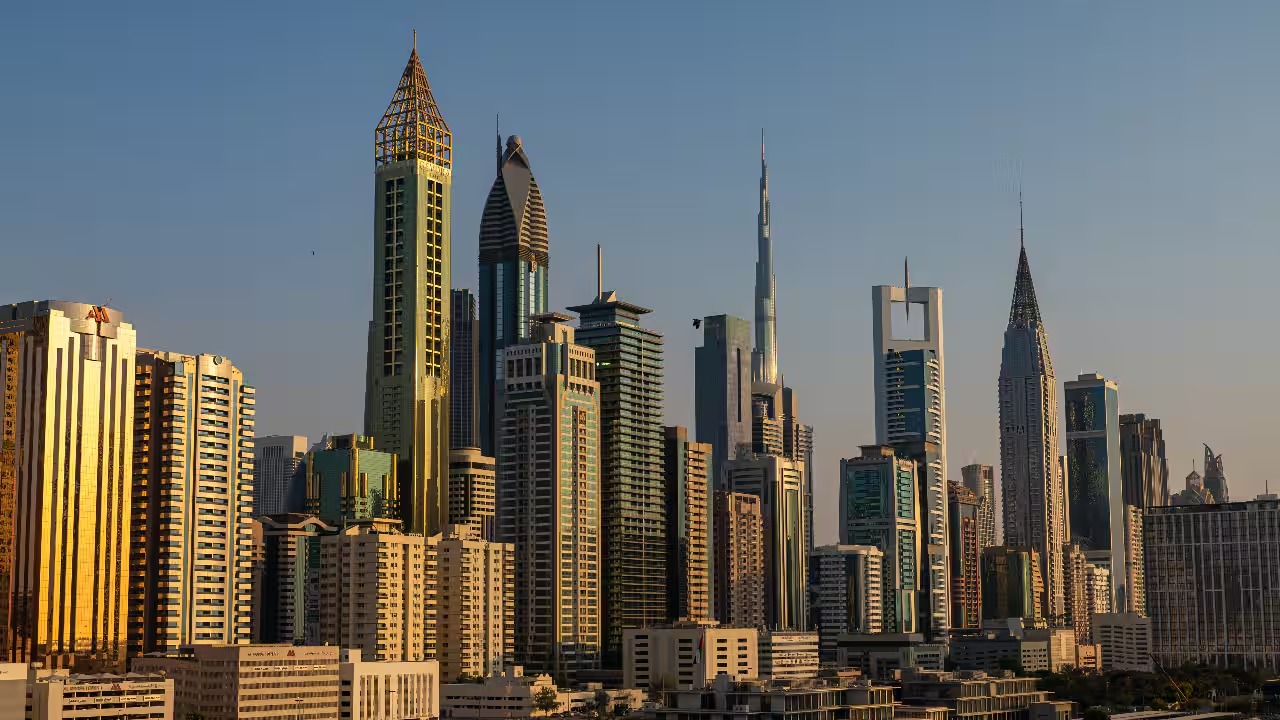

Indian investors have more choices than ever before. Yet one market keeps rising to the top of every serious conversation about overseas wealth building: Dubai.
The benefits of buying property in Dubai are not marketing language. They are measurable, verifiable, and increasingly well understood by the Indian investment community. This article breaks each one down clearly, in rupee terms, so you can evaluate the case on its own merits.
Why Indian Investors Are Paying Attention to Dubai in 2026
India’s domestic real estate market has delivered strong capital appreciation in certain cities. But appreciation alone does not build wealth sustainably. Rental yields, tax efficiency, currency stability, and asset protection all matter equally.

On every one of those measures, Dubai outperforms most Indian property markets today. The Dubai Land Department recorded Indian buyers as one of the top five nationalities transacting in Dubai throughout 2024 and into 2025. That trend has accelerated into 2026.
The question is no longer whether Indian investors should consider Dubai. The question is why more of them are not acting sooner.
How Dubai Compares to Indian Real Estate
Before diving into specific benefits, here is a direct comparison that puts the opportunity in context.
A mid-range 2BHK apartment in Mumbai’s western suburbs today costs between INR 1.5 crore and INR 2.5 crore. Rental yield on that asset is 2 to 3% gross. Annual property tax applies. Capital gains tax applies to the sale.
A comparable apartment in Dubai’s Business Bay or Jumeirah Village Circle costs approximately AED 700,000 to AED 900,000, roughly INR 1.6 crore to INR 2.1 crore at current exchange rates. Rental yield is 8 to 10% gross. Annual property tax: zero. Capital gains tax: zero.
The numbers are not close. And that is before accounting for the benefits covered below.
The Core Benefits of Buying Property in Dubai for Indian Investors
Each of the following benefits is individually significant. Together, they create a compelling case that is difficult to replicate in any other market accessible to Indian buyers under LRS.
Zero Property Tax Every Year
This is the single most impactful financial benefit for Indian investors coming from a market where property ownership carries consistent annual costs.
In Dubai, there is no annual property tax. Once you pay the one-time 4% DLD registration fee at purchase, your holding cost on the asset drops to service charges and maintenance only. Service charges typically range from AED 10 to AED 20 per square foot per year, depending on the building.
For an Indian investor used to paying property tax, municipal charges, and maintenance fees annually, this distinction changes the yield calculation significantly. Every rupee saved on tax is a rupee added to the net return.
8 to 12% Gross Rental Yields
The benefits of buying property in Dubai include some of the strongest rental yields of any major global city. Gross rental yields in Dubai’s top residential zones consistently reach 8 to 12%, according to data tracked by Knight Frank and ValuStrat across 2024 and 2025.
For Indian investors, this yield profile is transformative. Here is a simple illustration:
- INR 1.5 crore invested in a Mumbai apartment: 2.5% yield = INR 3.75 lakh annual rental income
- INR 1.5 crore invested in a Dubai apartment: 9% yield = INR 13.5 lakh annual rental income
That gap compounds significantly over five to ten years. And unlike Mumbai, the Dubai income arrives free of local tax.
Zero Tax on Rental Income
Dubai imposes no income tax on rental earnings. What you collect from your tenant is what you keep, minus property management fees if you use an agent.
Indian investors must declare Dubai rental income in their Indian tax returns under Schedule FA. However, the India-UAE Double Taxation Avoidance Agreement (DTAA) ensures you are not taxed twice on the same income. A FEMA-qualified CA can structure your filings to minimise your Indian tax liability on these earnings.
The result is a net rental yield that remains significantly higher than domestic alternatives, even after Indian tax compliance.
Zero Capital Gains Tax in Dubai
When you sell your Dubai property, the UAE levies no capital gains tax on the transaction. The full sale proceeds are yours to repatriate or reinvest.
Dubai’s property market has delivered capital appreciation of 40% or more in prime zones between 2021 and 2025, according to Knight Frank’s Dubai Prime Residential Index. Investors who bought off-plan in emerging areas during this period have seen even stronger gains at handover.
Note: You must declare the capital gain in India on your income tax return. DTAA provisions may reduce your Indian tax liability, but you should confirm your specific position with a qualified CA.
UAE Golden Visa Through Property Investment
One of the most talked-about benefits of buying property in Dubai among Indian investors is the UAE Golden Visa. This is a long-term residency visa tied directly to your real estate investment.
Here is how the threshold works:
- AED 750,000 and above: Qualifies for a 2-year UAE investor visa
- AED 2 million and above: Qualifies for the 10-year UAE Golden Visa
The 10-year Golden Visa includes residency rights for you and your immediate family, access to UAE banking services, and the ability to operate a business in the UAE without requiring a local sponsor.
For Indian professionals working across global markets, or families considering education options in the UAE, this visa represents enormous practical value beyond the investment return itself.
Flexible Off-Plan Payment Plans
Indian buyers face a structural challenge when investing overseas: the LRS annual remittance limit of USD 250,000 per individual. Dubai’s off-plan market offers a practical solution.
Most major developers, including Emaar, DAMAC, Binghatti, Imtiaz, Ellington, and Omniyat, offer staggered payment plans that align naturally with LRS cycles. Common structures include:

- 60:40 plans: 60% paid during construction, 40% at handover
- 50:50 plans: 50% during construction, 50% at handover
- Post-handover plans: A portion deferred for up to 3 years after handover
These structures allow Indian investors to buy property in Dubai from India by spreading payments across two or three financial years, each within the LRS limit. This is one of the most practical and underutilised tools available to Indian buyers.
Currency Hedge Against Rupee Depreciation
The UAE dirham is pegged to the US dollar. The Indian rupee has depreciated significantly against the dollar over the past decade.
This means that a Dubai property asset, priced in AED, automatically increases in rupee value as the rupee weakens. An Indian investor who purchased a Dubai apartment five years ago has seen both rental yield and asset value grow in rupee terms, driven partly by genuine Dubai market performance and partly by the structural currency gap.
This is passive currency diversification. It requires no active management and no separate financial instrument. It is built into the asset itself.
Entry Points Accessible Under LRS
A common misconception among Indian investors is that Dubai property is exclusively for ultra-HNIs. That perception is outdated.
Entry-level apartments in freehold zones such as JVC, Dubai South, and Al Furjan start from approximately AED 400,000 to AED 500,000. At current exchange rates, that translates to roughly INR 90 lakh to INR 1.15 crore. With a developer payment plan, the first-year capital commitment can be as low as INR 20 to 25 lakh, well within a single LRS cycle.
This makes the benefits of buying property in Dubai accessible to a much wider range of Indian investors than most people realise.
Additional Benefits Worth Knowing
Beyond the headline financial benefits, a few secondary advantages deserve mention for Indian buyers specifically.
No inheritance tax: Dubai levies no inheritance or estate tax. Your property passes to your heirs without a tax event in the UAE.

Strong legal framework: Dubai’s real estate sector is governed by RERA, one of the most investor-protective regulatory bodies in the region. The DLD’s mandatory escrow system for off-plan projects protects buyers throughout the construction period.
Remote ownership is fully supported: You do not need to live in or frequently visit Dubai to own and manage your investment. Property management companies handle tenanting, rent collection, and maintenance on behalf of overseas owners.
100-plus curated projects: At the Dubai Property Expo in India, investors get access to over 100 verified projects from top developers, all in one room, without the need to research each developer independently.
Frequently Asked Questions
What are the main benefits of buying property in Dubai for NRIs?
The key benefits are zero property tax, zero capital gains tax, 8 to 12% gross rental yields, UAE Golden Visa eligibility, and the currency hedge provided by the AED-USD peg. NRIs can also use NRE or FCNR funds for the purchase, bypassing the standard LRS annual limit that applies to resident Indians.
Is buying property in Dubai better than investing in Indian real estate?
For yield-focused investors, Dubai’s gross rental returns of 8 to 12% significantly outperform India’s 2 to 3% average. For capital appreciation, both markets have delivered strong results, but Dubai carries zero tax on gains on sale. The right answer depends on your individual goals, tax position, and time horizon.
Can I get a UAE Golden Visa by buying property in Dubai from India?
Yes. A property purchase of AED 750,000 qualifies for a 2-year investor visa. Purchasing above AED 2 million qualifies for the 10-year UAE Golden Visa, including family residency rights. Visa eligibility is confirmed at the time of DLD registration.
Are the benefits of buying property in Dubai available to resident Indians, not just NRIs?
Yes. Both resident Indians and NRIs can access all the benefits described in this article. Resident Indians use LRS remittance for the purchase. The USD 250,000 annual limit per individual applies, but off-plan payment plans allow purchases to be structured across multiple years.
Where is the best place to start if I want to buy a property in Dubai from India?
The most efficient starting point is attending the Dubai Property Expo in your city. You get direct access to verified developers, live market data, and personalised consultation — all in one room, for free, without travelling to Dubai.
Ready to Experience These Benefits Firsthand? Register Here
The benefits of buying property in Dubai are real, measurable, and available to Indian investors right now. Zero tax, 8 to 12% yields, Golden Visa eligibility, flexible payment plans, and a built-in currency hedge; this combination simply does not exist in the domestic market.
The Dubai Property Expo in India is where these benefits become tangible. You will meet verified developers from Emaar, DAMAC, Binghatti, Imtiaz, Ellington, and Omniyat, compare 100-plus projects, and take the first step toward owning a zero-tax Dubai asset from India.
Register for free at dubaipropertiesexpo.co.in and secure your seat at the next expo event in your city.